
Roof Sandwich Panels · 3-Rib Profile
3-Ribs Roof Sandwich Panels
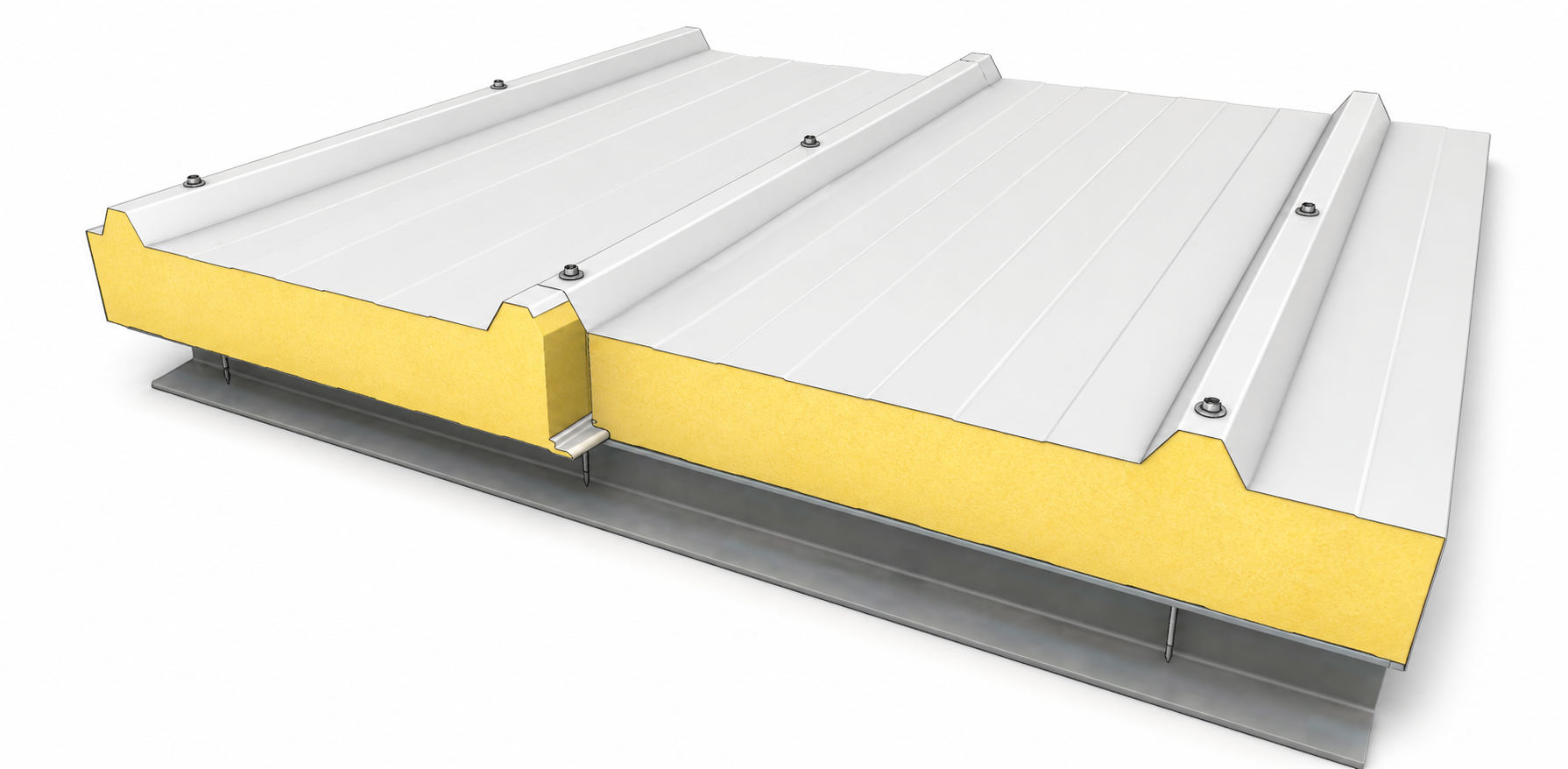
The 3-Ribs Roof Sandwich Panel is the three-rib variant of Jawdah's high-rib PIR roof panel, a profile with fewer, more widely spaced ribs across the panel width and broad flat troughs between them.
Rib count is the simplest way roofers describe a panel profile. A three-rib panel shows three raised ribs along its width, one of which normally forms the side lap with the next panel. The result is a bold, widely spaced rib pattern with generous troughs for water to run off.
The Jawdah source lists this variant by name only and states that roof panels are high rib. Cover width, rib height, rib spacing and span data are not published, so this page combines the Jawdah roof-family facts with general guidance on when a three-rib profile is a sensible choice.
- FamilyHigh-rib PIR roof panel
- GeometryConfirmed per project

Quick answer
A 3-rib roof sandwich panel is an insulated roof panel whose outer sheet has three raised ribs across its width, giving wide troughs and a strong, simple rib pattern. Jawdah offers it as a variant of its high-rib PIR roof panel, whose published U-values run from 0.73 to 0.22 W/m²K. Rib geometry and spans are confirmed by Jawdah per project.
What the three-rib profile is
On a sandwich roof the outer sheet is profiled so that it is stiff enough to span between purlins and so that the joints sit above the water. With three ribs per panel, the stiffness is concentrated in a few deep ribs and the flat areas between them are wide. That gives a clean, strongly modulated roof line that is easy to read from a distance.
Because each panel carries fewer ribs, the visual rhythm on a long roof or a canopy edge is calmer. The broad troughs also give water a wide path to the eave, which helps on long roof runs.
Jawdah roof-family data and pending item data
Only the product name is given for the three-rib variant. The roof-family statements below come from the Jawdah roof panel data and apply because the panel is part of the same high-rib PIR roof range.
| Topic | Status |
|---|---|
| Profile family | High rib lock and high rib external face |
| Internal face | Semi-corrugated or plain |
| Roof U-values | 0.73 (30/60), 0.44 (50/80), 0.30 (75/105), 0.22 (100/130 mm) W/m²K |
| Insulation core | PIR, stated to meet DIN 4102 B2 fire classification |
| Rib height, spacing and cover width | Confirmed per project |
| Span and load data | Confirmed per project |
How rib count affects a roof panel in principle
The load a profiled sheet can carry depends mostly on how deep its ribs are and how thick the metal is, not just on how many ribs it has. A three-rib panel puts its strength into a few deep ribs; the wide flat troughs between them are the least stiff part of the sheet. That is why rib count is always read together with rib height and sheet gauge, which Jawdah confirms per project.
Where a three-rib roof is a natural choice
Three-rib profiles are common on large industrial and storage roofs where a simple, robust profile and wide drainage paths matter more than a fine architectural pattern. Within the Jawdah roof applications, that fits factories, warehouses, hangars and pre-manufactured buildings.
- Long warehouse and factory roofs
- Hangar roofs with large uninterrupted areas
- Pre-manufactured and site buildings
- Industrial roofs where the roof line is seen from a distance
Points to confirm before choosing 3-rib
Give the Jawdah team the purlin spacing, roof slope, wind exposure and the expected maintenance traffic, and ask for the three-rib span data at the thickness you need. On roofs that will be walked on regularly, ask how the wide troughs should be protected and where walkways are needed.
Pick the thickness first from the roof thermal table on the Roof Sandwich Panels page, then confirm that the three-rib profile is available in that thickness and in the chosen facing and coating.
Common errors with three-rib roofs
Most issues come from assuming data that has not been confirmed.
- Assuming three ribs carry the same span as five without span data
- Walking in the wide troughs instead of on ribs or boards
- Choosing the profile before checking the thickness and thermal target
- Ordering ridge and eave fillers that do not match the three-rib shape
3-rib compared with 5-rib
Both are variants of the same Jawdah high-rib PIR roof panel. The 5-Ribs Roof Sandwich Panels variant places more ribs across the width, giving a finer pattern and stiffening the outer sheet at shorter intervals. Fillers and Roof Flashings must match whichever profile is chosen.
| Aspect | 3-rib | 5-rib |
|---|---|---|
| Rib pattern | Bold, widely spaced | Finer, closely spaced |
| Troughs | Wide | Narrower |
| Outer sheet stiffening | Fewer, deeper points | More frequent |
| Jawdah geometry data | Confirmed per project | Confirmed per project |

Key facts
- The 3-Ribs Roof Sandwich Panel is a three-rib variant of the Jawdah high-rib PIR roof panel.
- A three-rib roof profile has three raised ribs across the panel width and wide troughs between them.
- Jawdah roof panels have published U-values from 0.73 W/m²K at 30/60 mm to 0.22 W/m²K at 100/130 mm.
- Rib height, rib spacing, cover width and span data of the Jawdah 3-rib panel are confirmed per project.
- The internal face of Jawdah roof panels is semi-corrugated or plain.
- Roof profile strength depends mainly on rib depth and sheet thickness, not only on rib count.
RFQ / BOQ checklist
- Rib variant: 3-rib
- Roof thickness or U-value target
- Purlin spacing and roof slope
- Wind exposure and maintenance traffic
- External facing, coating and colour
- Internal face: semi-corrugated or plain
- Panel lengths
- Matching ridge and eave fillers and roof flashings
Closer look

Technical resources
Technical document
Technical data sheet: 3-Ribs Roof Sandwich Panels (Rev. 2)
English · 2.3 MB
Sent by emailRequest FileTechnical document
Product summary: 3-Ribs Roof Sandwich Panels
English · 284 KB
Sent by emailRequest FileTechnical document
Technical data sheet: 3-Ribs Roof Sandwich Panels (Rev. 12)
English · 10.2 MB
Sent by emailRequest FileTechnical document
Technical document: 3-Ribs Roof Sandwich Panels
English · 12.5 MB
Sent by emailRequest File
12–13In preparation
Further chapters in preparation
These parts of the product page are being prepared with the Jawdah technical team and will be published once verified.
Projects using this product
Project references are being prepared.
Compatible systems
System relationships for this product are being prepared.
Our technical team can share the current information on request.
Ask the technical teamFrequently asked questions
What is a 3-rib roof sandwich panel?
It is an insulated roof panel whose outer sheet carries three raised ribs across its width. Jawdah lists it as a variant of its high-rib PIR roof panel.
What are the dimensions of the Jawdah 3-rib panel?
Rib height, rib spacing and cover width are not published in the Jawdah source. Ask the Jawdah team for the three-rib profile drawing, which fixes these values for your project.
Which thicknesses can the 3-rib roof panel have?
Jawdah publishes roof thermal data for 30/60, 50/80, 75/105 and 100/130 mm. Confirm which of these are produced in the three-rib profile for your project.
Is a 3-rib panel stronger than a 5-rib panel?
Not necessarily. Strength depends mainly on rib depth and sheet thickness. Compare span data for both profiles at the same thickness before deciding.
Where is the 3-rib profile typically used?
On large industrial roofs, warehouses, hangars and pre-manufactured buildings where a simple robust profile and wide drainage troughs are wanted.
What internal face does the 3-rib roof panel have?
Jawdah roof panels have a semi-corrugated or plain internal face, which forms the visible ceiling inside the building.
What should I send for a 3-rib roof quotation?
Roof drawings, slope, purlin spacing, thermal target or thickness, facing and colour, flashings needed and the delivery location.

14Next step
Check the 3-rib profile for your roof
Send purlin spacing, slope and thermal target. The Jawdah team will confirm three-rib geometry, spans, fillers and a quotation.